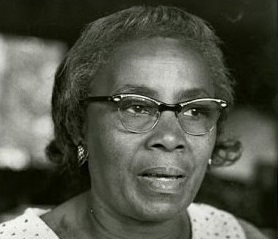
Who am I
My name is Septima Poinsette Clark (May 3, 1898 – December 15, 1987). I was an African American educator and civil rights activist. I strongly believe that knowledge can empower marginalized groups in ways that formal legal equality cannot.
What I do
I developed the literacy and citizenship workshops that played an important role in the drive for voting rights and civil rights for African Americans in the Civil Rights Movement. I was known as the "Queen mother" or "Grandmother" of the Civil Rights Movement in the United States. Martin Luther King Jr. commonly referred to me as "The Mother of the Movement".
Recent Posts
AsciiDoc is a first-class content format in Toph. Here's how to use it for blog posts.
Toph now supports blogging. Here's what's new and how to get started.
Education & teaching
Clark was born on May 3, 1898 to an American slave father and a free Haitian mother. From an early point in her life, her parents pushed Clark to pursue an education.
“When we were children, the one thing [my father] wanted was for us to have an education. This was the only thing that I know he would whip you for: if you didn’t want to go to school. There were times we didn’t want to go. I cried one morning I didn’t want to go to that school, and he whipped me with a strap and then took me down there”
— Charron-Cline
One thing that stood out to Clark as a Black student in the 1910s was the lack of Black teachers to teach children. Many segregated schools had white teachers teaching black children. This also led to Clark’s first experience with political organizing in 1919:
“So we had to do a door-to-door thing to get black teachers to teach their children. And in 1920 we got them. Oh, that thing had been coming a long time, but we hadn’t gotten to the place where we felt as if we could get the signatures before. I took my students along with me, and we got these signatures. Some would be across the street, and then I’d do it on the other side, and that’s how we did it”
— Charron-Cline
Ultimately, Clark was pushed towards education at an early age and soon realized the political power that education affords. This was a formational experience in her political activist career.
NAACP

As a political organizer, activist, and teacher in the Jim Crow South, Septima Clark overcame deceptive tactics to destroy racial coalitions like the NAACP. In 1954, Clark lost her teaching role and pension in South Carolina because of her role as the Charleston NAACP membership chair (Neumann). The South Carolina state legislature passed a law that no city or state employee could affiliate with a Civil Rights organization. Instead of keeping her job and renouncing membership, Clark refused to renounce her membership. But while some groups actively antagonized Civil Rights Movement leaders and organizers, others did attempt to help. But this was through the clumsiness of allies with good intentions but missing context. This was characterized in Clark’s connection with a South Carolina justice, Judge Waring, and his second wife, Elizabeth Waring. They were controversial as one of the few (or possibly only) White family in Charleston to speak up against segregation and racism. However, there are moments where Clark reflects on knowing her allies do not fully understand her or her community’s life.
“To be unmercifully truthful, I don’t really feel that Mrs. Waring had that much knowledge of the life of blacks. It was Judge Waring’s influence on her—that’s what I think—that imparted to her the fact that “I would like to change things.” She was like my mother, very high-strung, and very angry over things. She got angry with me when I said that she was vitriolic. She didn’t like that. But it was true”
— Charron-Cline
Despite the challenges of interracial relationships, Clark realized that all women were empowered through the role of teaching. This became a grounding aspect of her activism and enabled her to link her activism with civic duty and organization. The curriculum of her courses focused on learning to read and write in order to pass literacy tests, how to create a household budget, how to balance a checkbook, and how to apply for Social Security benefits (Charron-Cline). Her teaching was a vehicle for her to help other woman gain greater autonomy and independence of their own lives.
“First, when compared to losing one’s job, facing eviction from a white landlord, or risking one’s life by participating in direct action campaigns, teaching adults to read and write appeared a relatively safe entry point into the Movement.”
— Charron-Cline
Ultimately, despite these challenges and setbacks, Septima Clark was able to persist and continue her teaching through the Civil Rights period, even if it required relocating across the Southeast a couple of times.
Civil Rights Movement leader
The impact of Septima Clark and her work is often considered through her students. Her methods of public intervention were predominantly nonviolent (Neumann). She also believed in empowerment through education.
Her early role as a leader in creating Citizenship Schools enabled others to follow her precedent. She prepared a network of grassroots teachers in week-long training sessions on topics like how to recruit students, gauge educational levels, and develop lesson plans. She also ensured students were taught essential information like location and hours of the voter registration office and what health care and employment opportunities were available in their communities (Charron-Cline). Clark kept her Citizenship Schools curriculum relevant and updated to contemporary developments in the Civil Rights Movement.
“Training sessions and teaching classes afforded grassroots African American women the opportunity to evaluate the local problems they deemed most important while the Movement itself provided a vehicle for addressing them.”
— Charron-Cline
In this unique way, Clark’s impact goes beyond herself, but also to the many students who were taught under her leadership, and then returned to teach citizenship skills in their communities. This is also why she is sometimes left out of the retelling of history because her role was often behind the scenes and not visible. But she was a foundational piece of the Civil Rights Movement as an educator and Black woman leader (even if she viewed her gender as a separate matter from her race instead of from an intersectional point-of-view). Her role chain-amplified the growth of more decentralized leadership for the Civil Rights Movement at the local level in neighborhoods and Black communities.